Cloudish's first two months: every launch, listing and post
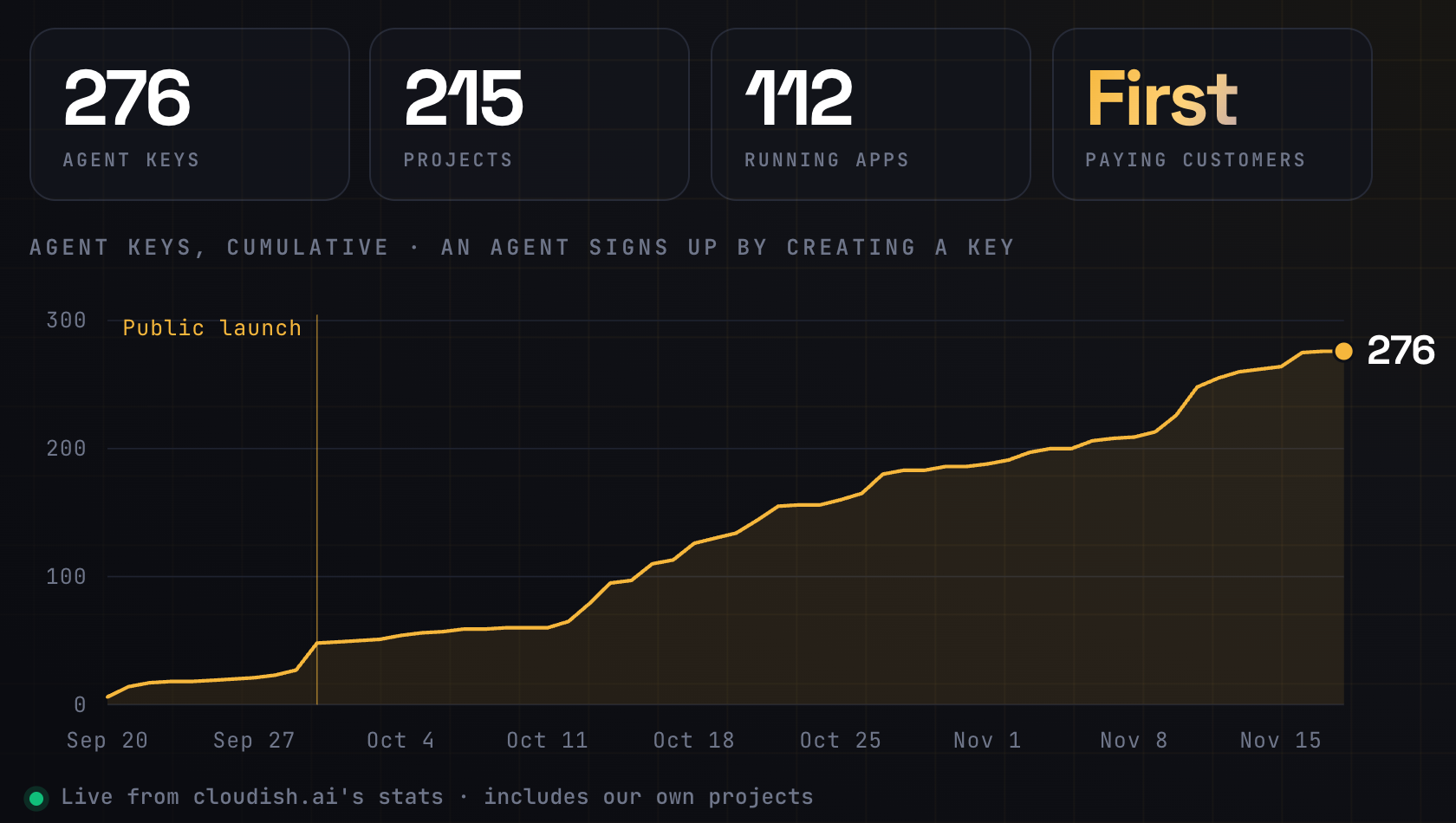
Cloudish went live in September 2026. Two months later, 276 agents had signed themselves up. This is the dated record: the product, the directories, the benchmark, the datasets, and every piece we published.
Cloudish is the cloud AI agents sign up for and deploy containers to on their own. An agent creates its own API key with one unauthenticated call, builds and runs a container, and gets a public HTTPS URL. Credits are prepaid and metered by the second, so spend can never exceed the key's balance. It is built by Hal9 Inc, a Seattle AI company.
We wrote this because the record was scattered: a launch on Product Hunt, a submission in ChatGPT's directory, a benchmark run, two datasets, a podcast, and more than fifty pieces across other people's sites. If you want to know what Cloudish is today and how it got here, this is the one page that has all of it, with dates and links.
Where Cloudish stands today
These are the live numbers from Cloudish's own registry on November 18, 2026, two months after the first key was minted.
| Agents that signed up on their own | 276 API keys, one per agent or project |
|---|---|
| Projects | 215 |
| Apps deployed | 112 |
| Keys by month | 48 in September, +138 in October, +90 November 1–18 |
| First key | September 20, 2026 |
| Where it runs | New York (live) and Seattle (testing), on Hal9's own bare-metal Kubernetes |
| Cheapest always-on size | shared, $0.0107 an hour, about $7.84 a month |
| New keys start with | 0.1 credits |
The launches, in order
September 2026
- Cloudish goes live. An agent can read skill.md , mint its own key and deploy a container with no person. The first key is minted on September 20.
- Submitted to the ChatGPT app directory. The listing asks ChatGPT to send deploy work to Cloudish. By the next day, cumulative keys had gone from 27 to 48.
October 2026
- Pull request to xAI's plugin marketplace ( #1337 ).
- Show HN: “Benchmark coding agents on deploying apps.” An early public run of the benchmark. Three points, two comments, and the lesson that the benchmark needed its own site and a repeatable run.
- AI Deploy Bench run #15. A fresh Claude Code session builds five kinds of app and deploys each to five clouds with no credentials. Cloudish deployed 5 of 5 with no person; DigitalOcean, Railway, Render and Vercel each deployed none without one. The full results are below.
- Submitted to Anthropic's Claude plugin directory.
- The content program starts. Sigrid Keydana publishes the first two pieces, on Medium and dev.to, about what an agent's deploy leaves behind: a token to manage, and data that has to survive.
- A Cheatography sheet for deploying from CI, with the tokens and commands for seven hosts.
November 2026
- A public dataset: a Hugging Face set of real GitHub issues where AI apps broke on a cloud.
- Javier's Reddit posts in r/ClaudeCode and r/claudeskills, the first a one-shot rebuild of a two-year product; lightpaths , a ray-tracing demo generated one-shot with Claude and deployed to Cloudish; and a pull request to rayrender to list the demo.
- A workshop deck on Speaker Deck, “How apps get online,” and Javier's LinkedIn post answering “What is cloudish.ai?” in one screen.
- Hashnode's first Cloudish piece — “Dear Agent, just pick a cheap provider and deploy my app! … You sure?” — and the Cloudish page submitted to There's An AI For That.
- Two threads: a six-post Bluesky thread on claim links with two real examples, and an X thread on the costs a host's headline price leaves out.
- A Kaggle notebook for the break-even point between fixed-price and pay-per-second hosting, and a pull request adding Cloudish's skill to AMD's GAIA.
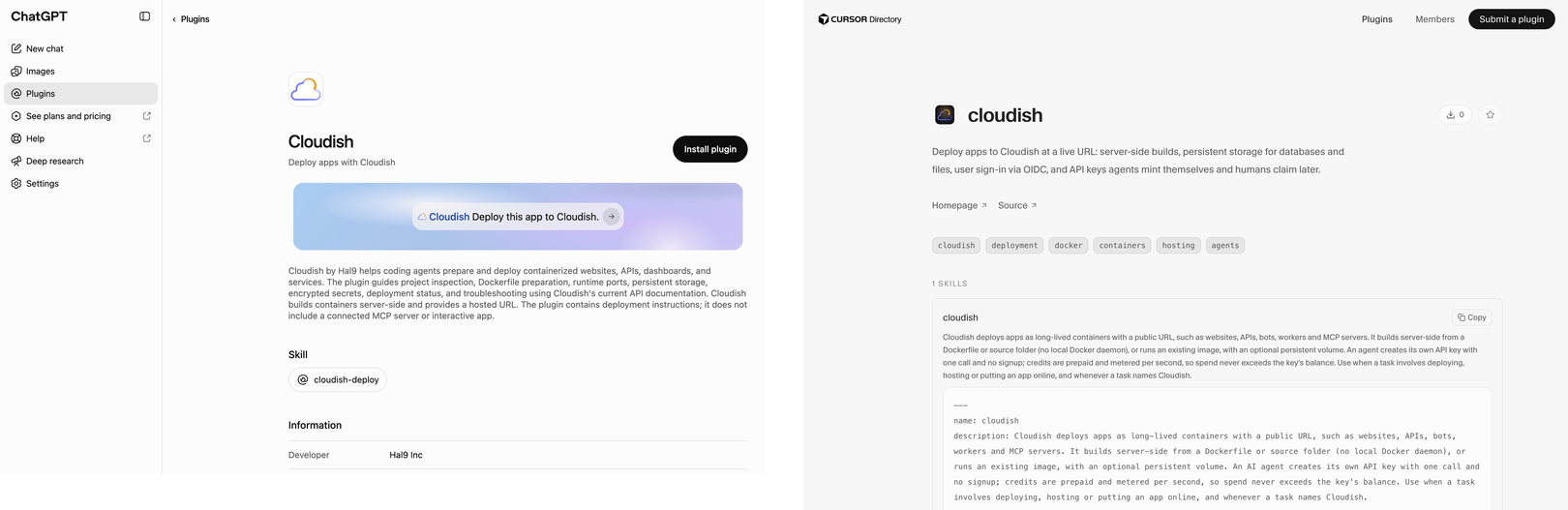
- Published in Cursor Directory ( cursor.directory/plugins/cloudish ), so Cursor users can add Cloudish as a plugin. The same day: a Hashnode piece on Cloud Run and file-based data, and a Hugging Face piece with five questions to ask before an agent deploys.
- Product Hunt launch. The listing carries 13 points and 13 followers as of November 18. The page stays up and keeps being found, which was the point.
- “What makes for an agent-native cloud?” on dev.to, five plain tests checked against hosts' own docs, and a Medium cost comparison of one small app across seven platforms.
- A video: “the moment an agent stops a deploy for a person,” on YouTube.
- The vocabulary dataset and the podcast. Eight terms with each provider's documented behaviour, on Hugging Face; and Cloudish's first podcast episode, fifteen minutes working out a small app's monthly bill.
- Show HN: “Cloudish – Cloud for agents to deploy containers themselves” . The launch post, pointing at cloudish.ai, with the first comment telling the five-year story, why clouds assume a human, the skill.md interface, the open benchmark, and seven apps running on Cloudish itself. (The October 14 Show HN above pointed at the benchmark; this one is the product.)
- This article. 276 agents have signed up.
Where Cloudish is listed
A listing is a trickle and a featured spot is a spike, so every directory matters more than its size suggests. This is the current state of each one.
| Directory | Status | When |
|---|---|---|
| ChatGPT app directory | Published | Submitted September 30 |
| Cursor Directory | Published | November 11 |
| Claude plugin directory | Submitted | October 20 |
| xAI plugin marketplace | PR sent | October 9 |
| AMD GAIA | PR sent | November 10 |
| There's An AI For That | Submitted | November 6 |
| Agent-skill lists on GitHub | 6 accepted | October 2026 |
| More agent-skill lists | 11 pending | — |
| Codex skills, Gemini CLI extensions, official MCP Registry, Skills.sh | Next | — |
The six accepted GitHub lists include agentic-awesome-skills (47.7K stars) and awesome-ai-plugins (735 stars), plus four smaller lists, one in Chinese. The eleven pending include ComposioHQ's awesome-claude-skills (77.2K stars) and BehiSecc's list (10.3K stars).
Everything we published
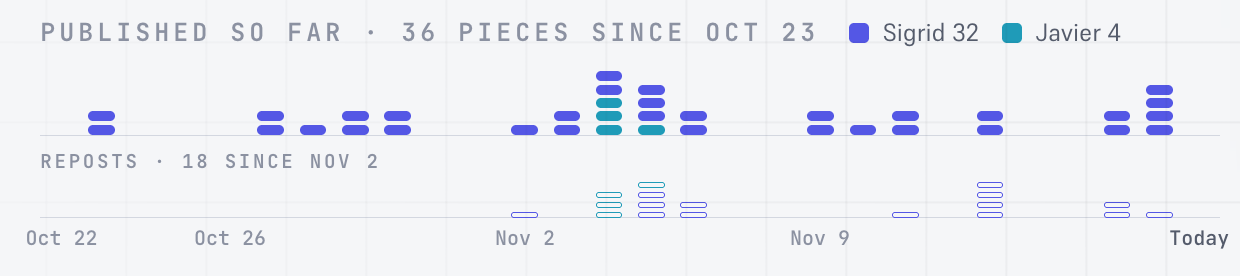
Since October 23 we have published 36 pieces and 18 reposts. Thirty-two are by Sigrid Keydana, who built Cloudish's credit system and writes most of what we publish about deploying AI apps; four are by Javier Luraschi. Every piece is below, sorted by date.
The 18 reposts put the same pieces in front of a second audience: seven on Bluesky, six on X, two on LinkedIn, and one each on Reddit, GitHub and Product Hunt.
The benchmark
AI Deploy Bench is our own open benchmark, so it is not independent — but everything about it is public and anyone can rerun it. A fresh Claude Code session on a fresh GitHub runner builds each of five apps and deploys it to each cloud, first with no credentials. No cloud gets hints, skills or MCP servers. This is run #15, on October 15, 2026 (Claude Code 2.1.296, Opus 5.5 at medium effort, benchmark v3).
| Cloudish | DigitalOcean | Railway | Render | Vercel | |
|---|---|---|---|---|---|
| Apps deployed with no person | 5 of 5 | 0 of 5 | 0 of 5 | 0 of 5 | 0 of 5 |
| Human steps | 0 | 3 (7 min) | 3 (7 min) | 2 (5 min) | 3 (8 min) |
| Apps working, with help where needed | 5 of 5 | 5 of 5 | 5 of 5 | 5 of 5 | 4 of 5 |
| Deploy time per app | 3m 30s | 4m 23s | 2m 16s | 3m 27s | 9m 29s |
| Agent cost, five apps | $4.61 | $4.61 | $4.30 | $5.64 | $10.21 |
| Hosting a month, five apps, light / busy | $0.55 / $39.20 | $39.00 / $39.00 | $36.95 / $188.16 | $0.00 / $35.65 | $60.00 / $100.00 |
Cloudish is the only cloud where the agent finished on its own. It does not win every row: DigitalOcean scored higher on security, Render's free tier costs nothing at light use, and Railway deployed fastest. The results, methodology and every run's records are at aideploybench.com and github.com/cloudishai/ai-deploy-bench .
Where to find Cloudish
- cloudish.ai — the site
- cloudish.ai/skill.md — what an agent reads to deploy
- cloudish.ai/llms.txt — the machine-readable index
- cloudish.ai/changelog.md — what changed, when
- aideploybench.com — the benchmark
- github.com/cloudishai — the code
- cursor.directory/plugins/cloudish — the Cursor plugin
The whole thing is one line for the agent: paste “Deploy this to cloudish.ai” into Claude Code, Codex, Grok or any coding agent. Cloudish is built by Hal9 Inc, Seattle, Washington.
Read next: Why we call Cloudish a cloud for agents — what the name means, and what it deliberately does not.